
An LLM, or large language model, is an AI system trained on large amounts of text so it can understand and generate language. ChatGPT, Claude, and Gemini are all built on LLMs. They are very good at reading, summarizing, and writing. They are not built to be a financial system of record, and they only know what was in their training data plus whatever you give them.
What does LLM stand for?
LLM stands for large language model. Each word tells you something:
▪ Large: it’s trained on huge amounts of text and has billions of internal settings, called parameters.
▪ Language: it’s built to work with words.
▪ Model: it’s a statistical system that learns patterns from data.
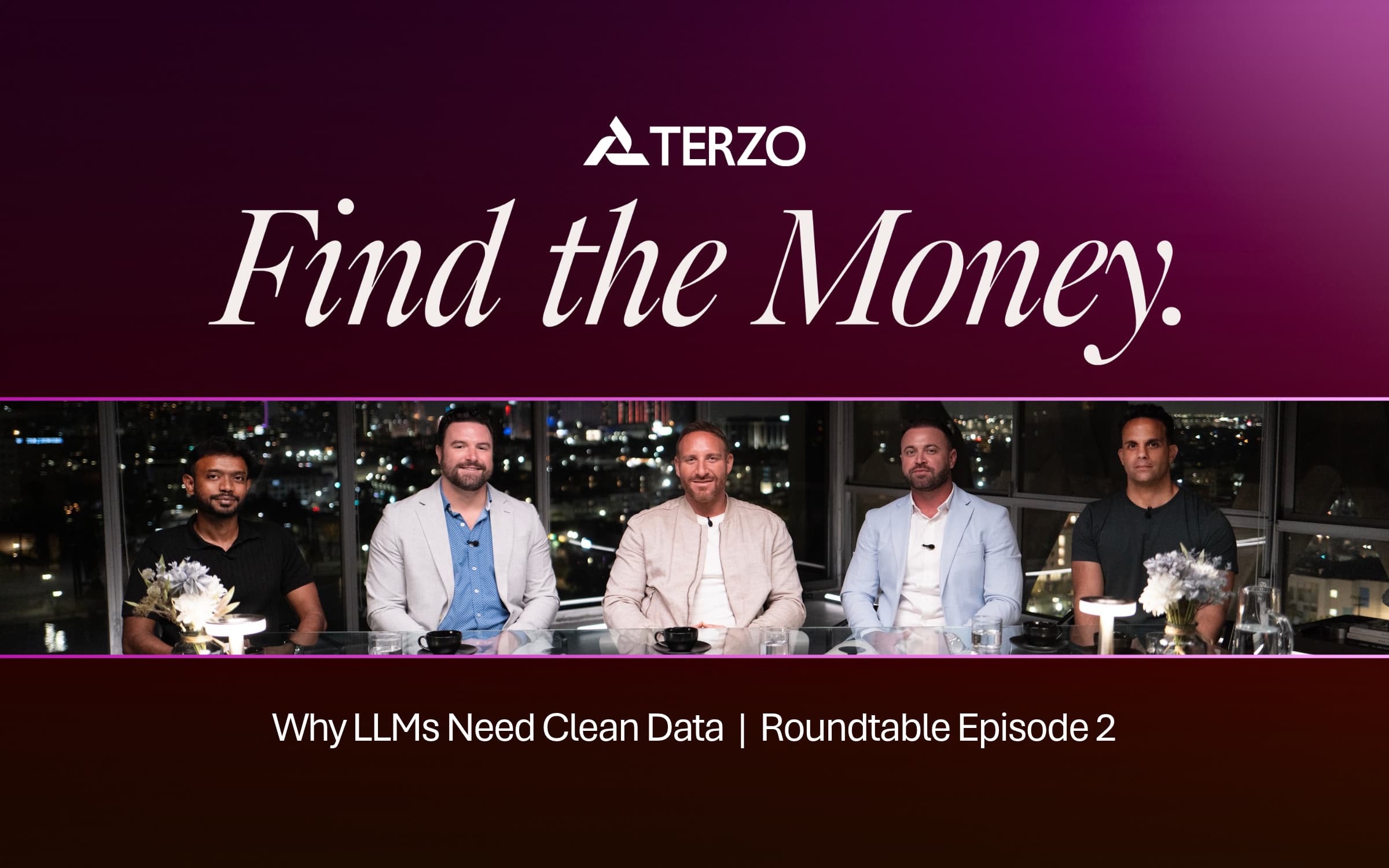
In Episode 2 of the Terzo Roundtable, Brandon Card, CEO & Co-Founder of Terzo, put it simply: “The middle L is language. It’s not a math model.”
How does an LLM work?
An LLM breaks text into small pieces called tokens. During training, it learns how those tokens tend to follow one another. When you ask it a question, it predicts the most likely next token, then the next, until it has written a full answer.
That’s why LLM answers sound fluent. It’s also why an answer can sound confident and still be wrong.
What are LLMs good at?
▪ Summarizing a long contract in seconds▪ Pulling out a specific clause or term▪ Answering questions about a document you provide▪ Drafting emails, memos, and reports
For a single document, an LLM is a powerful tool.
Where do LLMs fall short with enterprise financial data?
The problems show up at enterprise scale. There are three main limits.
They can only read so much at once. Every LLM has a context window, which is a limit on how much text it can take in at one time. As Zeyad Rajabi points out in the Roundtable, large enterprises have hundreds of thousands of contracts. No model can hold all of them at once.
They weren’t trained on your data. LLMs learn from public text. Your contracts, invoices, and payment records sit behind your firewall, so the model has never seen them. In Brandon’s words, “The financial data sets won’t let us behind the firewall.”
They’re built for language, not math. Finding the money means matching exact numbers. What did we agree to pay? What did we actually pay? Where does it not match? Answering that across thousands of suppliers takes precise reconciliation. An LLM predicts text. It isn’t designed to be the source of truth for financial figures.
Why clean data matters more than the model
Before any AI can find savings, the data underneath it has to be right. Spencer Ross describes the scale in the Roundtable: hundreds of thousands of contracts, thousands of suppliers, and millions of data points that have to be extracted, cleaned, normalized, and checked for accuracy. “There’s no army in the world that could ever go and do that properly,” he says.
Brandon sees the rise of LLMs as a good thing for that reason. The more companies use ChatGPT and Claude, the more of them discover how messy their financial data really is, and how much it matters to fix it.
How Terzo works with LLMs
Terzo builds the data layer first. We extract, normalize, and link contracts, POs, invoices, and payments into one connected financial record, behind your firewall. Trained humans in the loop verify what the AI finds.
Once the data is right, models like Claude, OpenAI, and Gemini can plug in and do what they do best, with the context they were missing.
“It’s actually a great thing that everyone’s using Claude and OpenAI,” says Brandon. “Now everyone’s realizing they have dirty data, and how important it is to go clean it.”
Watch the full Terzo Roundtable Ep. 2 above.
Ready to find your money? Book a Demo