
What Is a Large Language Model?
A large language model is an AI system trained on massive amounts of text to understand, generate, and reason about human language. The "large" refers to scale: billions of parameters, trained on books, websites, legal documents, financial filings, and virtually every other form of written human knowledge.
LLMs don't memorize facts. They learn relationships between words, concepts, and structures. That's what lets them summarize a contract, answer a question about clause language, or explain a procurement term without being explicitly programmed to do any of those things.
The most well-known LLMs are GPT (OpenAI), Claude (Anthropic), and Gemini (Google). Each is a general-purpose model, trained broadly and capable across many tasks.
How They Work
LLMs process text as tokens. When you send a prompt, the model reads every token, weighs the relationships between them based on training, and predicts what should come next. Frontier models today can hold entire contracts in memory at once and read complex legal language with audit-grade precision.
Three things make modern LLMs different from earlier AI:
Scale. More parameters and more training data produce qualitatively better reasoning, not just faster pattern matching.
Context windows. Models can now read a full contract, not just a few paragraphs, in a single pass.
Instruction following. You don't need to retrain a model for every task. Plain language instructions are enough to adapt its output.
Where LLMs Fall Short on Their Own
General-purpose LLMs are powerful. They're also built to be broad, not precise. In enterprise financial contexts, that gap matters.
Here's the core problem: if you hand an LLM a master services agreement for $1 million, an invoice for $1 million, and a purchase order for $1 million, it reads three documents referencing $1 million and may conclude you're looking at $3 million in spend. The actual answer is $1 million. Those three documents represent a single financial commitment at different stages of the same transaction.
An LLM reading documents in isolation can't know that. It doesn't have the enterprise context: the supplier relationships, the contract hierarchy, the mapped connection between what was agreed and what was actually paid. It has text. What it needs is structured financial data underneath it.
There's also accuracy. LLMs hallucinate, producing confident but wrong answers. In an enterprise financial context, where you might be reporting to the DOJ or managing a $500M spend base, 94% accuracy isn't close to good enough.
The AI Stack: Where Terzo Fits
Think of enterprise AI as a stack. At the bottom is infrastructure. Above that are the models. Above that are the applications built on those models.
The missing layer sits between the models and the applications: a structured financial data layer that connects what the LLM reads to what actually happened in the business.
Terzo sits in that layer. We ingest contracts, invoices, purchase orders, and ERP data. We extract 200+ fields per document. We map relationships between them: contract to supplier, clause to obligation, invoice to contracted rate. The result is the Financial Graph, a connected picture of every contractual commitment against actual spend, in real time.
When an LLM operates on top of that structure, it isn't reading isolated PDFs. It's reasoning across clean, verified financial data. The difference isn't incremental. It's the difference between a general-purpose tool and a system you can stake financial decisions on.
Terzo operates at 99% data accuracy. AI does the heavy lifting. Trained humans verify the output. Because the goal isn't a fast answer. It's a right one.
Terzo doesn't compete with LLMs. We enable them.
See it in action with your own contracts. Request a demo at today.
Frequently Asked Questions
What is a large language model (LLM)? A large language model is an AI system trained on large amounts of text to understand, generate, and reason about human language. Examples include GPT, Claude, and Gemini.
Why can't LLMs handle enterprise financial data on their own? LLMs read documents in isolation. They lack the enterprise context needed to connect a contract, invoice, and purchase order as a single financial commitment. They also hallucinate, producing inaccurate outputs that create unacceptable risk in financial workflows.
What is an AI-ready data layer? An AI-ready data layer transforms unstructured enterprise documents into clean, structured, contextualized data that LLMs can reliably reason across, producing accurate, traceable answers rather than best guesses.
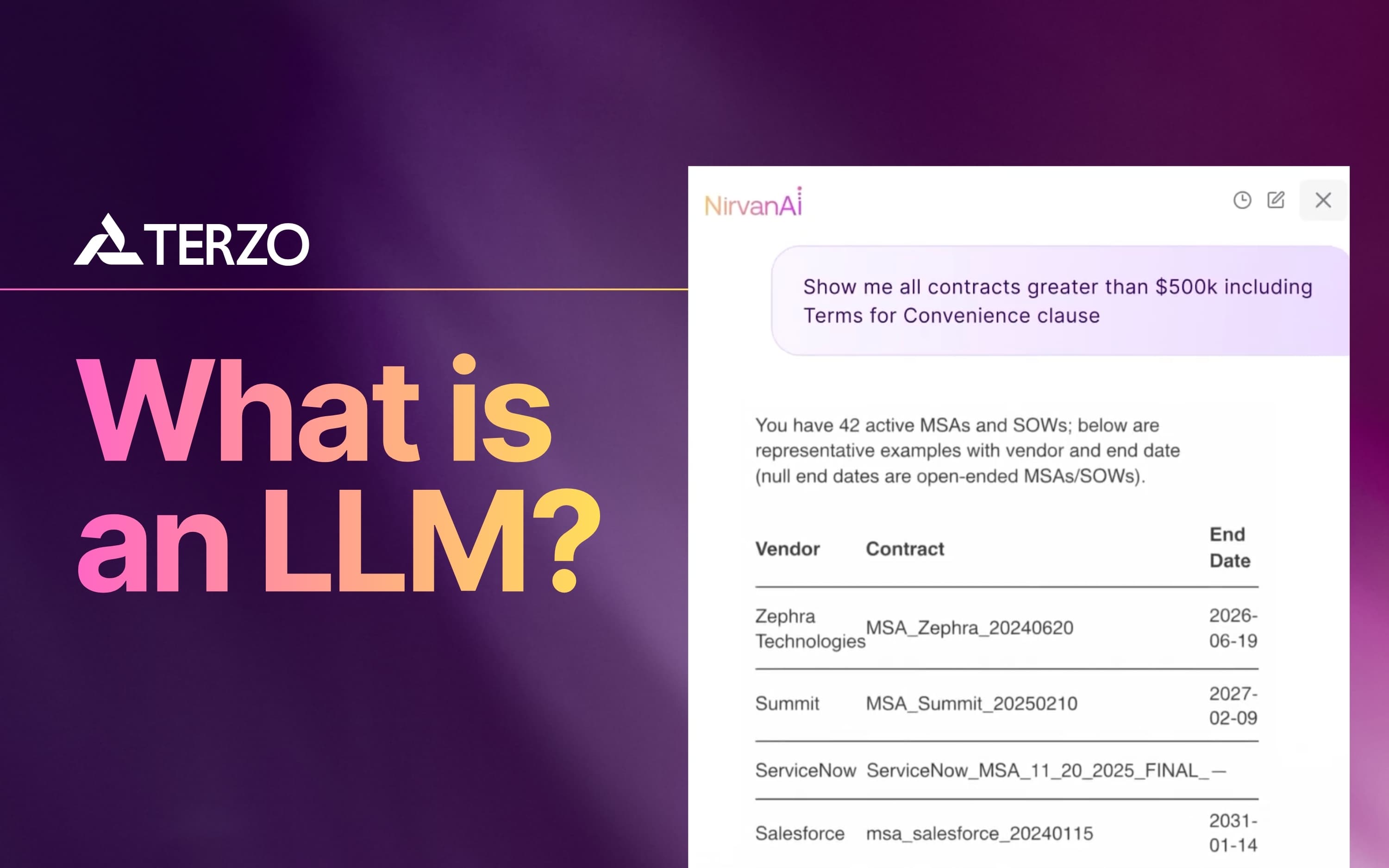
How does Terzo use LLMs? Terzo builds a structured financial data layer from enterprise contracts, invoices, POs, and ERP data, then uses LLMs to reason across that structure through NirvanAI. The result is financial intelligence accurate enough to report on and act on.
What is NirvanAI? NirvanAI is Terzo's contract intelligence product, powered by LLMs reasoning across the Terzo Financial Graph. It operates in Global, Document, and Compare modes to surface insights across your entire contract portfolio.
What is the Financial Graph? Terzo's Financial Graph maps every contractual commitment against actual spend, supplier relationships, and market benchmarks, creating a real-time connected view of how money flows across the enterprise.