
A contract is a financial asset because it sets the terms for how money leaves a company: the prices, rebates, payment terms, and renewal dates a supplier agreed to. Most enterprises still treat contracts as legal paperwork. The result is that finance runs the business on payment data alone, without the agreements that explain whether those payments were right.
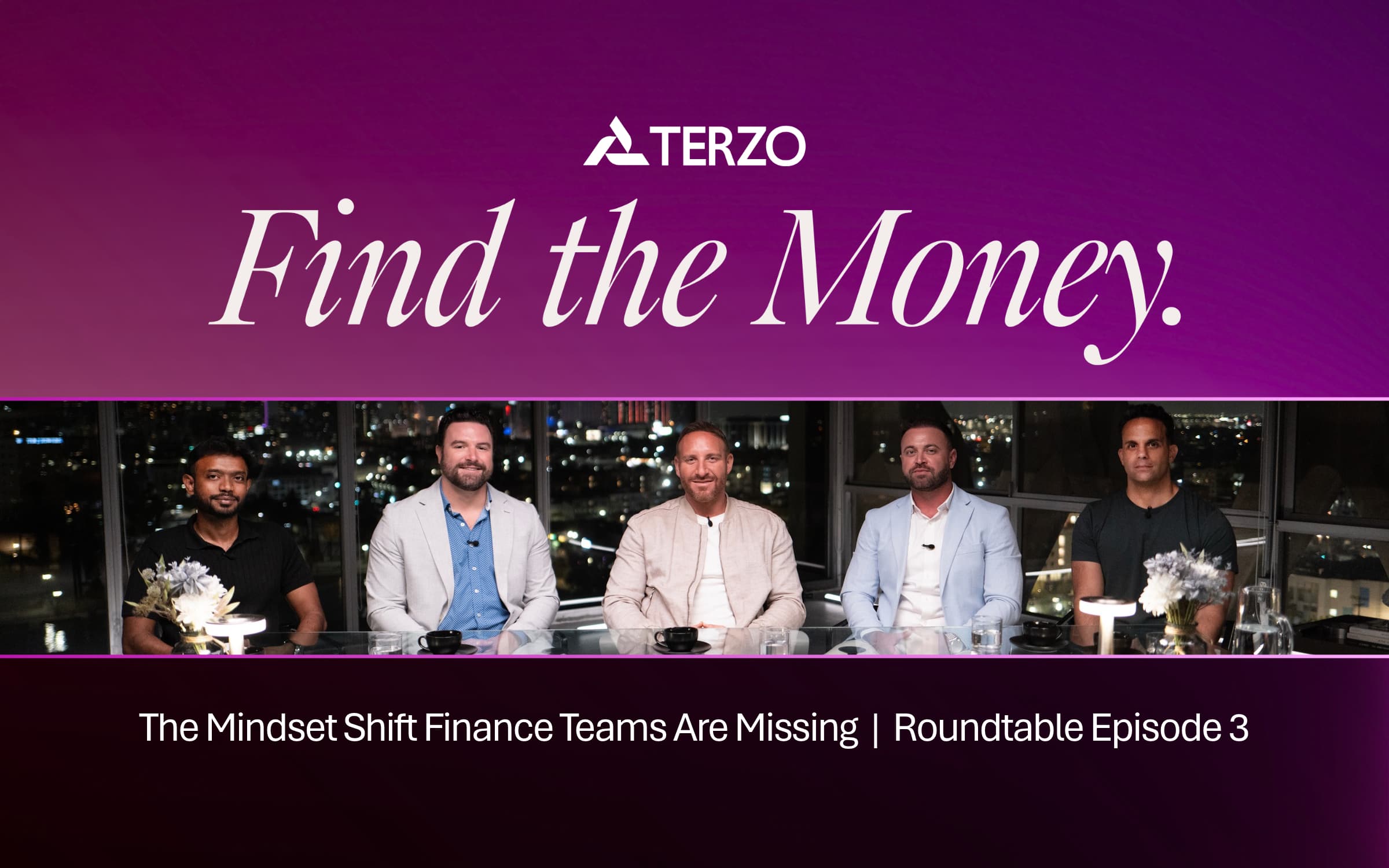
In Episode 3 of the Terzo Roundtable, Brandon Card, Pradeep Thangavel, Zeyad Rajabi, Daniel Haitz, and Spencer Ross talk about why contracts belong in finance, and why fixing the gap is more of a mindset shift than a technology problem.
Every time money moves, there's a contract
The episode opens with a simple point. "Contracts run the entire world," the team says. It doesn't matter whether you're running procurement at a global enterprise or buying a house or a car. Every time money moves, an agreement sets the terms.
In a large company, those agreements cover thousands of suppliers. Each one spells out what the business agreed to pay and under what conditions:
Unit prices and rate cards
Volume discounts and rebates
Payment terms
Renewal dates and notice windows
That is financial data. It just happens to be stored as PDFs that finance rarely sees.
$200 million on an ERP, and still no contract data
Brandon has heard the same answer throughout his career, at Oracle, at Microsoft, and now with Fortune 500 companies at Terzo. A finance team spends $200 million on an SAP implementation, then tells him it doesn't have its contract data.
"That's where all your financial data is," he says in the Roundtable.
The ERP tells you what you paid. The contract tells you what you agreed to pay. When finance runs the company on the ERP and never connects it to the contracts, nobody can check whether the two match. Billions in commitments sit in documents that no one reviews.
Why 60,000 contracts can't be managed by hand
The scale makes the problem worse. A large enterprise can have 60,000 contracts or more. In the episode, the team asks how much sense it makes to hand that volume to an operations team and expect them to know:
Where to find the right agreement
Which rate applies
How to buy against it
Which procurement channel to use
No team can do that reliably at that size. So purchases get made off-contract, rates get missed, and invoices get paid without anyone checking them against what was agreed. Every year the volume grows, and the team's capacity to review it doesn't.
A mindset shift, not a technology gap
The tools to fix this already exist. What used to take months can now be done in minutes. As the team puts it, "this is really more of a mindset shift than it is anything else."
That shift starts with how a company classifies its contracts. When they're filed as legal paperwork, they stay with legal. When they're treated as financial assets, finance expects to see the terms inside them, just as it expects to see the ledger.
Terzo connects contracts, purchase orders, invoices, and payments into one financial record. Finance can see what was agreed, what was paid, and where the two don't match, with the source documents behind every finding.
Connect what you agreed to with what you paid
Contracts already hold the answers finance is looking for. The work is getting that data into the same place as the payments.
"The fact that finance people don't have the contract data, to me, is the craziest thing in business," says Brandon Card, CEO & Co-Founder of Terzo.
Watch the full Terzo Roundtable Ep. 3 above.
Ready to find your money? Book a Demo