
An ERP records what a company paid. A CLM stores what it agreed to pay. Neither system compares the two, so neither one can tell finance where money is leaking across suppliers. Most enterprises fill that gap with a one-time spend analysis, and that report starts going out of date the day it arrives.
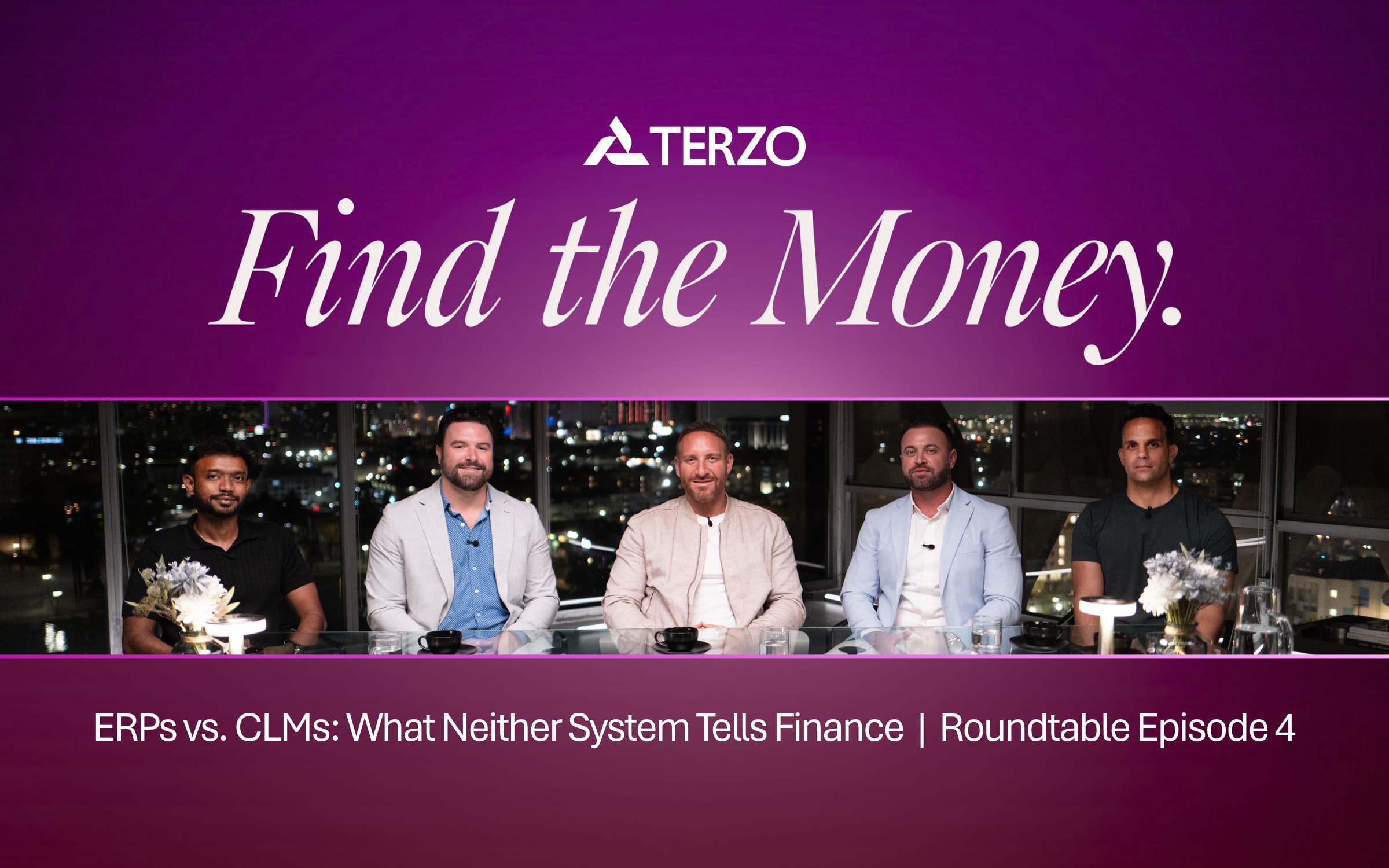
In Episode 4 of the Terzo Roundtable, Brandon Card, Pradeep Thangavel, Zeyad Rajabi, Daniel Haitz, and Spencer Ross talk about what ERPs and CLMs were built to do, why the consulting model can't keep up, and what it looks like when finance has a current view of its money every day.
What ERPs and CLMs were built to do
Both systems are good at the jobs they were designed for. The trouble is that finding the money isn't one of those jobs.
ERPs are transactional. An ERP is the financial system of record. It logs purchase orders, invoices, payments, and the general ledger. It can tell you what a supplier was paid last month. It can't tell you whether that was the right amount.
CLMs were built for attorneys. A contract lifecycle management system handles the work before signature: drafting, review, approvals, and storage. As the team puts it in the Roundtable, CLMs cover "everything from pre-signature and authorization to develop the document." Once a contract is signed, it mostly sits in the repository.
The price a company agreed to is in one system. The price it actually paid is in another. Nobody built the bridge between them.
Why one-time spend analysis is "stale upon arrival"
When a company wants to know where it's losing money, it usually brings in a consulting firm. The firm pulls contracts and spend data, reconciles them by hand, and delivers a report a few months later.
Daniel Haitz, Terzo's Head of Global Partnerships & Growth, spent years on the delivery side of those projects. His view now is blunt. The analysis is "stale upon arrival."
The reason is simple. A consulting study is a point-in-time project. As soon as someone signs a new contract the following week, the data is old. Prices change, renewals come up, and new suppliers get added, but the report stays the same.
That lag is where the money goes. By the time anyone spots an overcharge, it has usually been paid for months. A renewal that already closed can't be renegotiated. Terzo wants to partner with consultants, not replace them. The problem is the model, which gives finance a snapshot of money that moves every day.
A $200 million ledger with no terms in it
One Terzo customer spent $200 million on an ERP implementation. After all that, the system held none of the company's contracts, terms and conditions, or obligations. It had a general ledger of accounting data and nothing else.
As the team says in the Roundtable, the company was "paying that much money just to track their money into a ledger." The ERP could show every dollar that went out. It couldn't show whether any of those dollars matched what the company had negotiated.
This is common at enterprise scale. Most large companies built their financial systems one at a time, so the payment data and the agreement data have never been in the same place.
From a one-time report to a morning brief
Terzo takes a different approach. It connects agreements, purchase orders, invoices, and payments into one financial record and reviews them continuously, so the picture stays current instead of aging on a shelf.
The Roundtable describes what that looks like day to day. You log into Terzo in the morning, and it has already done the work. It tells you:
What changed since yesterday
What each change is worth
Which actions to take today to drive savings
The team calls this the morning brief. It isn't another dashboard or another report. It's a short list of actions with the evidence behind each one.
Spencer Ross, Terzo's Director of Global Sales, sums it up in the episode: "Now we have the system that understands your money."
Measured by what it tells you to do
ERPs and CLMs will keep doing their jobs. What finance needs is a layer that connects them and shows where the money is going.
"I believe the next generation of enterprise AI won't be measured by what it shows you," says Brandon Card, CEO & Co-Founder of Terzo. "It'll be measured by what it tells you to do about your money."
Watch the full Terzo Roundtable Ep. 4 above.
Ready to find your money? Book a Demo