
Enterprise waste has stayed hidden because the data needed to find it is too large and too messy to clean by hand. Finding it means comparing hundreds of thousands of contracts with millions of invoice and payment records, and until recently the technology to do that accurately didn't exist. AI changes that, but only once the data underneath it is right.
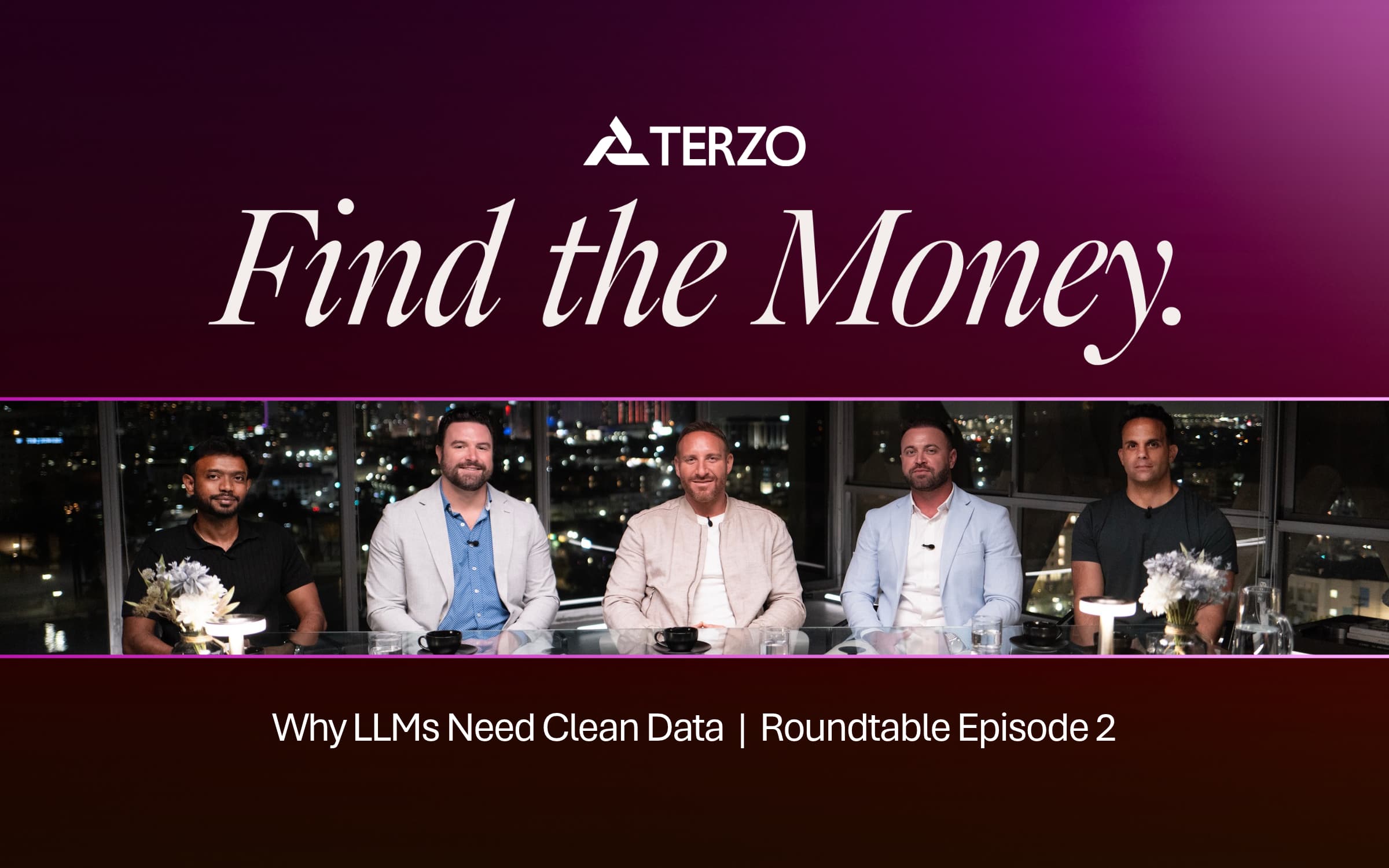
In Episode 2 of the Terzo Roundtable, Brandon Card, CEO & Co-Founder of Terzo, sits down with Spencer Ross, Daniel Haitz, Pradeep Thangavel, and Zeyad Rajabi to talk about why the waste has gone unseen for so long, and what it takes to find it.
"No army in the world" could clean this data by hand
An estimated $3 trillion a year in enterprise waste is widely accepted. So why hasn't anyone recovered it? The team's answer in the episode is direct: "We did not have the technology."
Spencer Ross lays out the scale. A large enterprise has hundreds of thousands of contracts and thousands of suppliers. That adds up to millions of data points, and every one of them has to be:
Extracted from the source document
Cleaned
Normalized so it can be compared with everything else
Verified for accuracy
"There's no army in the world that could ever go and do that properly," Spencer says. Without that work, nobody can line up what was agreed with what was paid, so the waste stays out of sight.
How the AI boom is exposing dirty data
Brandon sees the rush to adopt AI as good news. Executives everywhere are using ChatGPT, Claude, and Gemini. The minute they point those tools at their own financial data, they find out how messy it is.
Every new AI rollout ends up showing a company how much of its own data needs cleaning before the tools can deliver.
That realization matters. For years, bad contract and spend data was a back-office problem that rarely reached the C-suite. Now it's the thing standing between a company and the AI results it was promised.
Why LLMs hit a wall at enterprise scale
Large language models are powerful, but they can't clean enterprise financial data on their own. The Roundtable points to three limits.
They can only read so much at once. Every model has a limit on how much text it can take in at one time. A customer with hundreds of thousands of contracts is far past that limit.
They're built for language, not math. "The middle L is language," Brandon says. "It's not a math model." Finding waste means matching exact numbers across contracts, invoices, and payments, and that takes precise reconciliation.
They were never trained on your data. Contracts and financial records sit behind the company firewall. Public models have never seen them.
The stakes leave no margin. As the team puts it, "You're making billions of dollars of decisions on this data. No room for errors at all."
Get the data right first, then put AI on top
Terzo was built around the data problem first. In the episode, the team describes picking up that mantle because there was real enterprise value waiting on the other side of it.
That focus is what large customers have responded to. Some of those corporations talked to 3,000 startups before choosing Terzo. What stood out, the team says, was that Terzo understood the data infrastructure problem well enough for AI to work on top of it.
Terzo extracts and connects contracts, purchase orders, invoices, and payments into one financial record, behind the customer's firewall. Trained humans in the loop verify what the AI finds. Once the data is right, any model can plug in and find savings.
Clean data is how AI finds the money
The $3 trillion hasn't stayed hidden because nobody looked. It stayed hidden because the data wasn't ready. Fix that, and AI can finally do what companies hoped it would.
"It's actually a great thing that everyone's using Claude and everyone's using OpenAI," says Brandon Card, CEO & Co-Founder of Terzo. "Now everyone's realizing they have dirty data, and now they realize how important it is to go clean it."
Watch the full Terzo Roundtable Ep. 2 above.
Want to see what's hiding in yours? Bring a few contracts and let's find your money. Book a Demo